

Optimizing Equipment Foundation Delivery Through Design-Build and Delegated Design
By Chad Hensley, PE, Executive Vice President, Concrete Group, Wayne Brothers and Joseph Wickline, PE, President, Southern Engineering Company (a Wayne Brothers company)
In the first article of this series, we discussed how construction of equipment foundations often carries additional risk compared to common building foundations. This second article examines how a design-build or delegated design approach can reduce those risks, mitigate scope gaps, and improve outcomes.
Siloed Scopes Increase Costs
New build industrial projects often have one entity, typically a GC, who has the scope to construct the building shell while the Owner/OEM retains the responsibility for installing the equipment foundations. Building foundations, specialty slab-on-grade, and/or equipment foundations are frequently designed and bid as separate scopes. Each element and its installation are often designed and planned in silos without adequate regard for the overall project needs. In other words, each entity optimizes their own solution, but the system as a whole is not evaluated. This matters because the optimal combination is what brings the best value to the end user, as further described below.
“When a deep foundation or ground improvement system and structural mat slab are designed in isolation, each solution may work on its own, but the interface between the two may not.”
Siloed Design Leads to Inefficiency
Fragmented design and division of responsibility can produce layered conservatism when the respective design teams work in isolation. Geotechnical recommendations include factors of safety, then structural engineers utilize those recommendations and add further conservatism in foundation design. Those compounding layers of conservatism can result in deeper excavation, heavier reinforcing, and more complex formwork than truly required for an adequate design. The described scenario increases cost and complexity unnecessarily. Beyond close coordination between geotechnical and structural engineers, involving the constructor in evaluating different combinations can bring constructability into the mix while seeking the optimal solution. The savings may be significant in cost or schedule, and quite often represent an improvement in both.
Better Decisions Get Made When Everyone Is at the Table
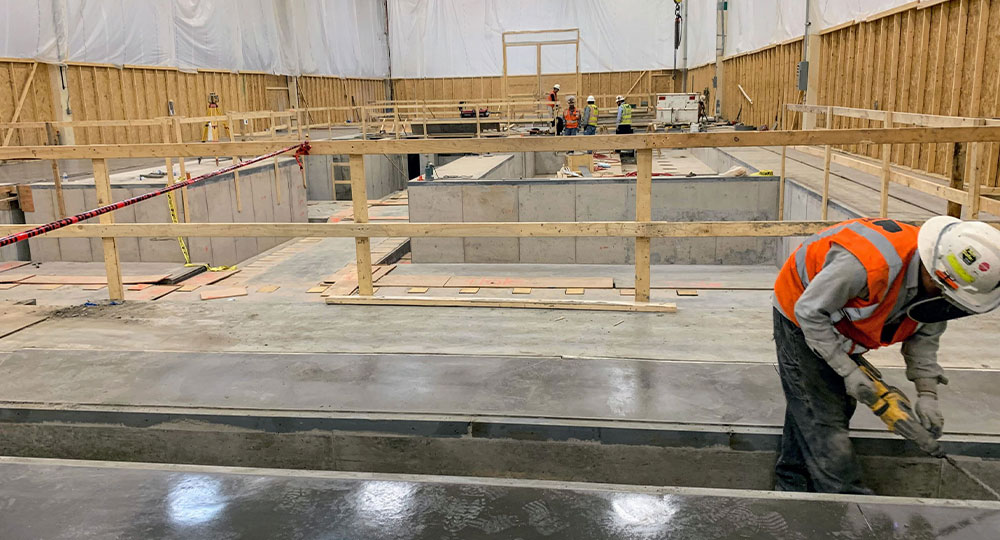
A well-executed design-build or delegated design approach enables the design team, construction professionals, equipment manufacturers, and Owner to collaborate from the initial engagement, with a shared understanding of site conditions, constraints, and risk. That shared knowledge makes it possible to explore different combinations and evaluate tradeoffs to settle on the best solution. It often requires reprogramming the typical approach by investing more money in upfront design and construction collaboration and planning. This investment pays off in a final product that meets or exceeds the end user’s needs, delivered reliably on schedule and at a controlled cost. Conversely, in a design-bid-build scenario, design decisions are made without input from the contractor who will actually do the installation. What looks good on paper is not always the most efficient way to build. Access, sequencing, excavation methods, reinforcing congestion, and concrete placement should be considered alongside structural requirements, not after them.
“The most successful equipment foundations are the ones designed with a clear understanding of how the work will actually be built.”
Early Integration Is the Best Risk Management Tool on the Project
The risks outlined in Part One do not disappear on their own. They are best managed when collaboration among engineering, site investigation, and construction planning begins very early in the design process. Equipment foundations are rarely the largest scope on an industrial project, but they are frequently on the critical path. Treating them as an integrated challenge rather than a series of handoffs is one of the most effective ways to protect schedule, control cost, and reduce rework. Wayne Brothers and Southern Engineering Company bring this integrated approach to all of our design-build and delegated design projects.
ABOUT THE AUTHORS
Chad Hensley, PE is a partner and Executive Vice President of Concrete at Wayne Brothers, which he joined in 1999. He holds a BS in Civil Engineering from NC State University and has over 30 years of experience managing concrete, civil, environmental, and highway construction projects. Within the American Concrete Institute, Chad has served as chairman of the Construction Liaison Committee, Secretary of Committee 305 (Hot Weather Concreting), ACI Financial Advisory Committee, ACI Membership Committee, and currently serves on the Board of Directors for the ACI Center of Excellence for Advancing Productivity, among other committee roles.
Joseph Wickline, PE is President of Southern Engineering Company, a wholly owned subsidiary of Wayne Brothers Companies, where he became a partner in 2025. He holds a BS in Civil Engineering from West Virginia University and an MS in Civil Engineering with a structural emphasis from Virginia Tech, and brings over 20 years of experience in civil and structural engineering. Joe is a licensed Professional Engineer in multiple states and an active industry leader, serving on the board of the ACI Carolinas Chapter, as a voting member of ACI Committee 351-0C (Dynamic Equipment Foundations), and as an associate member of ACI Committees 207 and 351-00.
Sign up here to receive our newsletter three times a year
Return to the newsletterShare This Post


Keep Up With Wayne Brothers
Return to the News page for more updates. Any questions? Shoot us an email.
Back to News Contact Us