

Why Specialty Equipment Foundations Create Hidden Risk on Industrial Projects and How to Manage It
Authors: Chad Hensley, PE, EVP Concrete Group (Wayne Brothers) and Joseph Wickline, PE, President (Southern Engineering Company)
Equipment foundations often introduce more schedule and construction risk than typical building foundations, especially on industrial projects in operating facilities. In this two-part series, we explore why these risks occur and how to manage them.
Incomplete Equipment Information Drives Risky Early Assumptions
Equipment foundations can vary from simple mat slabs to deep, complex multi-staged installations. They often include embedded plates, angles, anchor bolts with tight tolerances, recesses, ledges along with flatness and levelness requirements that exceed what is required for other types of foundations.
One common issue is the lack of necessary information about the equipment at the onset of design. It is most helpful if the complete loading and dimensional requirements are provided prior to the design effort and prior to the construction planning effort. More complex foundation installations require a detailed planning effort with sequential processes that are difficult to change once construction is underway. A variety of concrete shapes and embedded items often result in a challenging reinforcing design and potential conflicts with anchor bolts and other embedded items.
In the construction industry, we have been conditioned to ask questions, make educated assumptions if we don’t get answers, and proceed with work (if possible). However, specific to complex equipment foundations, changes in the design once construction is underway exacerbate impacts through the entire installation affecting excavation, formwork, reinforcing, etc. The mentality of ‘we will catch it before installation’ will inevitably result in more effort, expense and time to design and install the same product.
To mitigate, whomever is procuring the equipment should understand receipt of complete, rely upon design information by a contractual date is as important as the receive on-site date of the physical equipment.
Subsurface Conditions Often Go Unverified Until Construction Begins
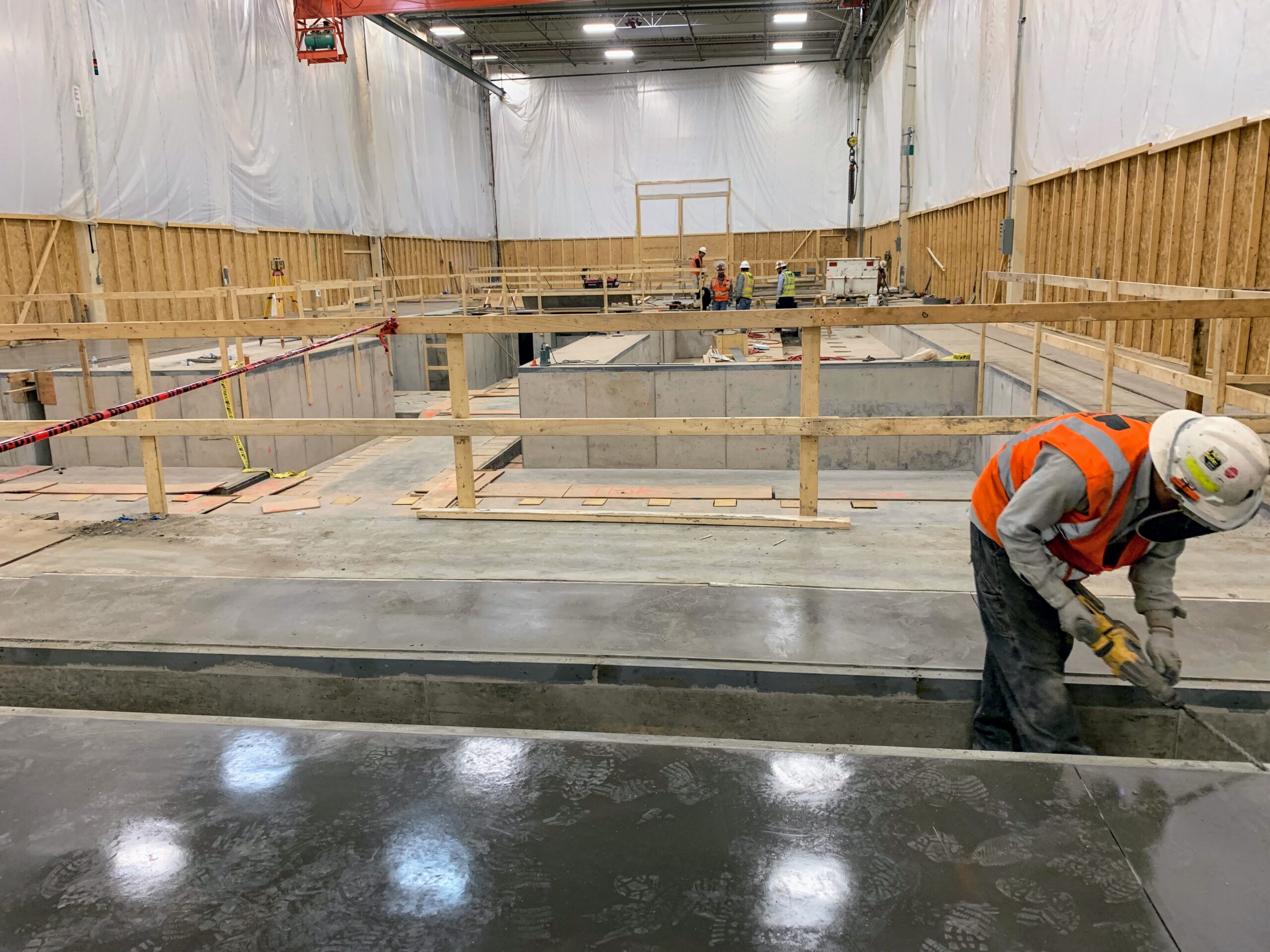 Subsurface uncertainty is another common challenge when installing specialty foundations. Even with a geotechnical report, soil conditions are only known where testing occurred. In existing facilities, access for investigation may be limited by operations or installed equipment. Design teams often must extrapolate conditions to locations not directly tested. Those assumptions are verified only once demolition or excavation begins.
Construction Techniques Depend on Soil Conditions
Soil conditions can affect design strategy as well as installation methodology. Excavation methods, soil stability, formwork approach, and safety measures vary significantly between clay, sand, or mixed soils. In some regions, earth formed foundations are feasible and efficient. In others, broader excavation and fully formed concrete placements are required, adding time and cost. To minimize the impact to cost and schedule, determining the soil conditions at the actual location of the planned installation is worth the upfront cost to avoid unnecessary changes later. Having this information available and planning for appropriate design and construction will help achieve the best results for the project owner and all other stakeholders.
Sequencing Complexity Creates Schedule Risk
As with any construction process that requires a defined sequence of events, when a step in the sequence is disrupted or delayed it is difficult to make up the time. This is especially true when the work is linear and a disruption leaves crews with nothing left to do but wait for resolution. Equipment foundations frequently include multiple elevations, grade beam or wall tie-ins, slab turndowns, and embedded steel items that must be installed in sequential order. Generally, that order starts with the lowest elevation with subsequent activities stacking until you get to the final step. Having the design completed and the construction sequencing planned prior to fabrication release of reinforcement and embedments are two of the best strategies to control the installation schedule.
“What looks like a small change in design can quickly become a major construction issue once excavation, reinforcing, and sequencing are already underway.”
Why Specialty Equipment Foundations Deserve Holistic Attention
Many of these challenges could be reduced by considering equipment foundations earlier and more holistically with the overall project. Equipment placement can influence column locations (or visa-versa), foundation depths, and sequencing decisions. There are helpful tools for planning successful installation of building foundations and specialty equipment foundations in the most efficient manner. A 3D model of all concrete elements is helpful to see the relative dimensions and elevations of the concrete elements. When combined with models from other trades, it is helpful visualizing clashes, planning logical work sequencing, pour breaks, etc.
When equipment foundations are deeper than nearby building foundations, they often need to be constructed first. Otherwise, unplanned shoring or underpinning can significantly impact cost and schedule. Many of these risks can be reduced through earlier coordination between design, geotechnical investigation, and construction planning.
Sign up here to receive our newsletter three times a year
Return to the newsletterShare This Post


Keep Up With Wayne Brothers
Return to the News page for more updates. Any questions? Shoot us an email.
Back to News Contact Us